AI implementation for operators

I put AI to work inside your finance and operations. Then I stay until your team runs it without me.

You bought the tools. Nothing changed. What was missing is the workflow, built inside the systems you already run.

Guennael Delorme. Ran Samsung's US retail finance, planning, procurement and logistics: $150M budget, close to 30,000 doors, 700 FTEs. Built, then ran, two $100M+ programs from zero.
Book 30 minutesHow an engagement runs
Finance and operations teams

Reporting, close, audit support, the second brain

Inside the ERP and the spreadsheets people actually open. Starts with the Operator's Diagnostic.

How an engagement runs

Almost every PE leader is doing something with AI. Almost none would bet on passing an outside audit in ninety days.

99%
of private equity leaders are exploring, piloting, scaling or embedding autonomous AI
9%
are very confident they could pass an independent AI governance audit within 90 days

Grant Thornton, 2026 AI Impact Survey. 100 private equity fund leaders, February to March 2026.

Vendors will sell you agents. What you are missing is the workflow they run inside: a named owner, a baseline number, a rule for what the machine may touch. That is not a technology problem.

Waiting is not neutral either. It is another year of seats nobody audits, a close that still waits on one person, and the number you own moving the wrong way while the pilot stays a pilot.

What it looks like when it works

Four things operators ask me for, each inside what you already own, each with an owner's name on it.

The monthly package that assembles itself

Sponsor and board reporting pulled from the ERP and the bank feed, commentary drafted before the controller opens the file.

Instead of: three days of copy and paste
Runs in: your ERP and one shared workbook

Audit support that is already collected

Evidence matched to the request list as transactions happen, not the week the auditors arrive.

Instead of: the spring scramble
Runs in: your document store

A close that stops waiting on one person

Reconciliations, accruals and intercompany, matched in shadow mode until the machine agrees with your people.

Instead of: the accountant everyone waits for
Runs in: the general ledger you have today

The second brain

How the company actually runs, written where a machine and a new hire can both read it.

Instead of: asking the one person who knows
Runs in: a knowledge base you keep when I leave

If your ERP already does one of these, I will tell you to switch it on and go home.

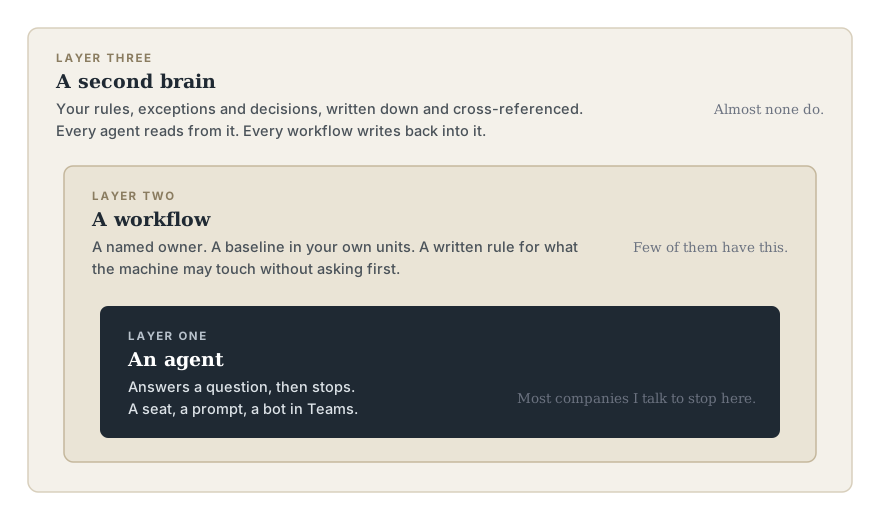
Agents are not a workflow. A workflow is not a second brain.

Agents

Most companies I talk to have them: a ChatGPT seat, a "board of advisors" prompt, a bot in Teams.

A workflow

Few companies have one: a named owner, a baseline, a rule for what the machine may touch.

A second brain

Almost no company has one: the one place your rules, exceptions and decisions are written down and cross-referenced, that every agent reads from. Your controller retires. The reason that accrual is booked that way does not retire with them.

Mine runs my company. About 40 agents in tiers, 87 skills, a wiki of several hundred verified pages, and a loop that turns every correction into a rule the next session obeys.

It is not a build I finished. It corrects itself, it links what I would not have linked, and it is better this month than last.

See the builds
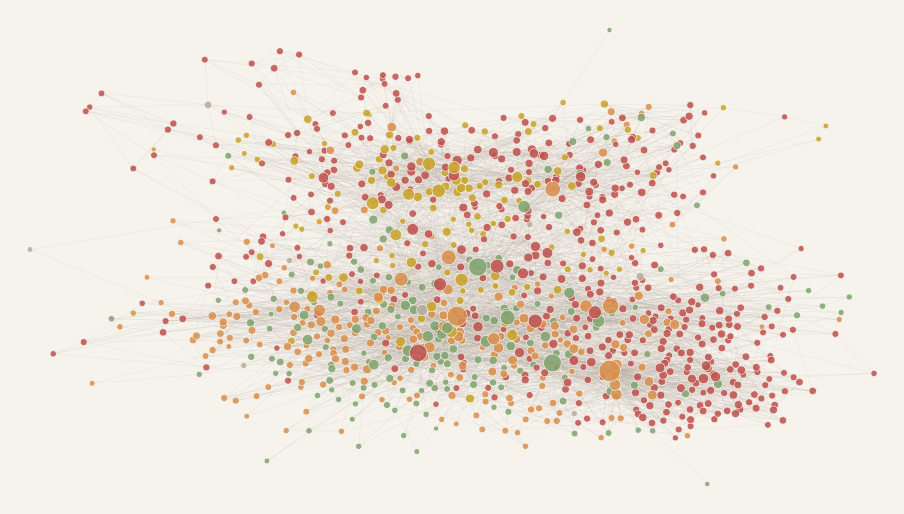
The wiki as a graph: about 500 pages and the links between them
The wiki, September 2026. Every dot is a verified page the agents read; every line is a cross-reference. Green: people. Orange: companies. Red: frameworks and concepts. Ochre: sources and syntheses. The index and the change log are left out.
How an engagement runs

Three steps. The first can end with "do not build yet."

Step two

Build, with your owner

One or two days a week, with the person who will run it.

  • A knowledge foundation you own
  • Six acceptance tests, written first
  • Shadow mode until the output earns promotion
Step three

Run, measured

Priced per agent in production, not per hour of me.

  • A weekly ledger of hours returned against your baseline
  • The next agent only when the first is used
Why an operator

The same act, four industries, before AI was the tool

Energy, 2011 to 2013TXU Energy, retention strategy

Attrition from 25% to 12% while raising price, by testing the levers everyone had stopped questioning.

Mobile, 2014 to 2019Samsung, co-founder and GM

Built, then ran, the world's first certified pre-owned phone program and the first trade-in program run by a phone maker. $100M+ each. Net recovery up 19 points in 60 days.

Retail finance, 2020Samsung US retail operations

Head of finance, planning, procurement and logistics: $150M budget, close to 30,000 doors, 700 FTEs, a direct team of nearly 20. Answered for the numbers to the CFO every month.

Insurance, 2021 to 2025SquareTrade / Allstate, VP and GM

Built, then ran, a global trade-in business inside an insurer that had never had one. Three countries. Closed the first two accounts myself.

Advisory, 2021A wireless handset wholesaler, advised at CEO level

A product line at 20% gross margin was losing money on every unit. Nothing was built. The range widened and the line turned.This is what the Diagnostic sells

AI implementation, 2026A PE-backed multi-site operator

Four weeks, two site visits, seven deliverables. The biggest item on their automation list was an ERP feature they already paid for, switched off.

Things I will say that a vendor will not

What you may hear from me

  • "Do not build yet." Your data cannot carry it.
  • "Your ERP already does that." Keep the money.
  • "Nobody owns this number." So nothing gets built.
  • "You are done." No retainer.

Who this is not for

  • A team looking for a platform recommendation.
  • A company where nobody can name who owns the workflow after I leave.
  • Anyone who wants the demo before the baseline.
  • A sponsor who has already mandated an AI partner across the portfolio.
"Let me see first if I can help you. If I can, we sign an agreement. If I cannot, I do not want your money."To a company that offered me a retainer in 2026.
Guennael Delorme

About

CELX Advisory is me, Guennael Delorme (G to most people). Started in 2021 after Samsung, advising in reverse logistics, trade-in and asset recovery: a little over ten years of my career.

In 2026 it became the home for AI implementation, because that is what the operators who called were asking for.

Thirty minutes. You get my read before you decide anything.

Where AI is landing inside finance and operations teams like yours, where it is not, and what that means for the number you own. Bring the workflow that annoys you most. You will leave with a different set of questions for your team, and those are yours whether or not you ever hire me. Whether we work together is a separate question, and if the answer is no I will say so.

Book 30 minutesguennael@celxadvisory.com